
The AI Trends That Actually Matter for SMBs in 2026
- Feb 3
- 7 min read
Updated: Mar 26
By George A. Papazian | Galyx™ AI Guidance for Small Business Owners
Published February 2026 · Estimated read time: 8–10 minutes

Every January, the internet gets flooded with "AI trends" articles that read like vendor press releases. Lots of buzzwords, very little guidance on what you should actually do on Monday morning.
So let me try something different. I've been watching how small businesses are actually adopting AI, not how analysts say they should, but what's working in the real world for companies with 5 to 100 employees, lean teams, and real budget constraints. What follows is my honest read on the six trends that will matter most for SMBs this year, including a few that the big tech media is getting wrong.
Fair warning: some of these will challenge assumptions you might have. I think that's worth something.

Trend 1: Agentic AI Is Coming for the Small Business Back Office
For the past two years, AI for most small businesses meant one thing: generating content faster. Blog posts, social captions, and email drafts. Useful, but ultimately a productivity upgrade, not a transformation.
2026 is different. The shift happening now is from AI that answers questions to AI that takes actions.
These are called AI agents, and the practical version for small businesses looks something like this: A lead fills out your contact form. An AI agent checks their company size, looks up their LinkedIn profile, qualifies them against your criteria, sends a personalized intro email, and schedules a discovery call, without you touching it. You wake up to a confirmed appointment with a prequalified prospect.
"AI agents are now accessible to businesses with as few as five employees, starting from $20 per month per agent." — Digital Applied, 2026
That's not a future scenario. Tools like Zapier AI, n8n, and Make are already doing this for SMBs today, at price points that make it hard to justify NOT implementing.
The honest caveat: agents work best on well-defined, repetitive workflows. If your processes are chaotic or undocumented, the agent will automate the chaos. Fix the workflow first, then automate it.
Trend 2: From Generic AI to Specialized AI — and Why It Matters for You
There's a Gartner analyst named Paul Furtado who made a prediction that got less attention than it deserved: he believes public, general-purpose AI will become irrelevant to businesses within two to three years. What will replace it? Niche, customized AI trained on industry-specific data and tailored to specific workflows.
I think he's onto something important for SMBs, even if his timeline is aggressive.
The businesses getting the most out of AI right now aren't just using ChatGPT or Claude for everything. They're using specialized tools built for their vertical. There's AI software built specifically for HVAC companies, for law firms doing contract review, for restaurants managing inventory, and for medical practices handling scheduling and intake.
These vertical AI tools outperform general-purpose AI for specific tasks because they're trained on domain data. An AI that's processed 10,000 HVAC maintenance contracts understands things about that workflow that a general model never will.
The actionable advice here: before you spend another month trying to prompt-engineer ChatGPT into handling your industry-specific work, search for "[your industry] + AI software 2026." You might be surprised by what already exists at surprisingly reasonable prices.
Trend 3: AI Literacy, Not AI Adoption, Is the New Competitive Edge

Here's a number worth considering: 57% of small businesses are now investing in AI technology, up from 36% in 2023, according to a Business.com study published last month. That's a massive adoption curve in two years.
But adoption numbers obscure a more important divide. Most small businesses using AI are using it for the same basic tasks: drafting content, answering customer questions, and maybe summarizing documents. The gap isn't really between AI users and non-users anymore. It's between businesses where someone actually understands how to use AI well and businesses where everyone's just clicking buttons and hoping for the best.
LinkedIn's research team found that AI literacy is now one of the top differentiators for SMB growth. What does AI literacy mean? It's not coding. It's not prompt engineering in the technical sense. It's knowing what these tools can and can't do, how to give clear instructions that produce useful outputs, and how to evaluate whether the output is good.
Practically, this means investing in training your people, even informally. The consulting firms doing the best AI work I've seen aren't the ones with the most sophisticated tools. They're the ones where every team member has spent real time learning how to work effectively with AI, baking it into their processes rather than treating it as a novelty.
If you have employees, this year's most valuable investment might be a few hours a week of structured AI training, not a new tool subscription.
Trend 4: Hyper-Personalization at Scale Is Finally Within Reach
Five years ago, delivering truly personalized customer experiences required marketing teams, sophisticated CRMs, and a significant budget. Big brands did it. Small businesses watched enviously.
That gap has closed. Fast.
AI can now analyze individual customer behavior — what they've bought, what they've browsed, what emails they've opened, what questions they've asked — and generate genuinely personalized outreach, recommendations, and offers, automatically, at scale. A 10-person service business can now deliver the kind of personalized customer experience that only enterprise companies could pull off a few years ago.
The numbers are hard to argue with. Customer service chatbots have produced roughly a 20% increase in retention rates for businesses using them. Personalized email sequences consistently outperform generic blasts by 15 to 25% in conversion rates. These aren't marginal improvements.
The interesting strategic question for 2026 is how small businesses use this to differentiate themselves from larger competitors. A big company has advantages in brand awareness, resources, and distribution. But they often can't move fast, and their customer interactions can feel generic and transactional.
A well-run SMB with good AI personalization can feel more like a trusted advisor than a vendor. That's a competitive position worth protecting.
Trend 5: The "AI Skeptic" Moment Is Coming. Don't Get Caught Flat-Footed.
I'm going to say something that goes against the grain of most AI content you'll read this year: we're heading into a period of AI disappointment for a significant number of small businesses.
Here's why. Over the past two years, businesses adopted AI with high expectations and often little planning. They subscribed to tools, got initial results that seemed impressive, and assumed the value would compound. For many, it hasn't. The tools that generated quick wins got incorporated into workflows, but then plateaued. The bigger transformation never materialized.
According to Gartner, over 60% of AI projects fail to move beyond pilot phases due to unclear objectives and poor implementation planning. That's not a technology failure. That's an execution failure.
"2026 is the year businesses finally started asking the harder question: Is it working?" — SS&C Blue Prism, AI Agent Trends 2026
The businesses that will come out ahead aren't the ones that adopted AI first. They're the ones who adopted AI thoughtfully, with clear metrics, specific use cases, and honest accountability about results.
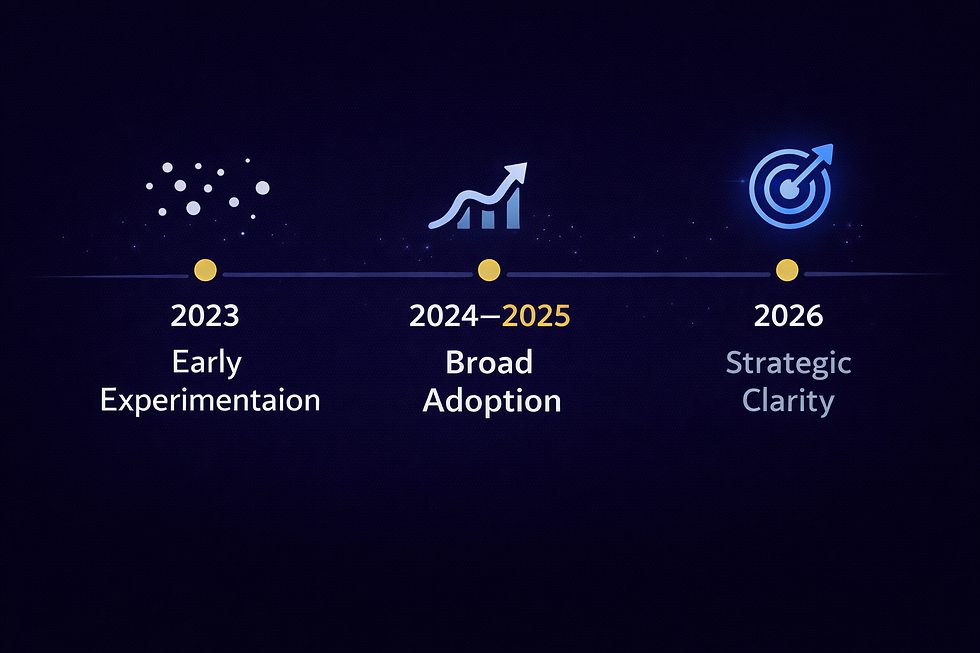
If your AI tools feel like they're running on autopilot without a clear ROI, this year is the time to audit. Kill what isn't working. Double down on what is. The "just try things" phase of AI adoption is over. Strategic clarity is the differentiator now.
Trend 6: AI and the Tariff Economy — A Small Window of Opportunity
This one's worth raising because it's the context in which small business owners are operating right now.
The US Chamber of Commerce's economic team projects slow-to-moderate economic growth through 2026, with inflation still running above the Fed's 2% target and interest rates remaining elevated for at least the first half of the year. Tariff uncertainty is adding cost pressure on businesses with supply chain exposure.
That sounds like a reason to hunker down. I think it's a reason to lean into AI even more.
When revenue growth is slower and margins are tighter, the businesses that survive and pull ahead are the ones that find ways to do more with the same team. That's precisely where AI delivers. A $150/month AI stack that eliminates 20 hours of manual work per month while improving lead conversion is a better investment in a tight economy than it is in a boom.
The competitive window isn't closing. It's getting wider for disciplined operators right now, because many of your competitors are pulling back. The businesses that use this economic moment to build better AI-powered processes will be disproportionately positioned when growth returns.
What to Actually Ignore This Year
Every trends article should have one of these sections.
AI-generated everything. The novelty of AI-generated content has faded. Customers can often tell, and it reads as low-effort. Use AI as a starting point and collaboration tool, but put human judgment and voice back into anything customer-facing. LinkedIn's research found that SMBs doing best in content trust are leaning into authentic human voices, not volume-optimized AI output.
Any AI tool with a week-long onboarding. If implementation requires a dedicated project, consultants, and months before you see value, it was built for enterprises that can absorb that overhead. Move on and find a tool that delivers results in hours or days.
Replacing people with AI before your processes are solid. AI amplifies what's already there. If your sales process is broken, an AI sales tool will execute that broken process faster. Build the process, then automate it.
Where Small Businesses Actually Stand
The data is clear: 87% of SMBs using AI report a positive impact. Adoption is up sharply. The tools are genuinely better than they were 18 months ago.
But 56% adoption also means 44% of small businesses are still largely sitting this out. And among those who've adopted, most are using AI for surface-level tasks rather than the deeper operational work that drives real competitive advantage.
That's the honest picture. And it means the opportunity is still real for businesses willing to go a level deeper than their competitors.
The trends above aren't predictions about what's coming in three years. They're describing what's happening now, in small businesses, with tools that exist and are affordable. The question is just whether you're going to engage with them seriously this year or spend another 12 months watching from the sideline.

Good decisions start with good information. Galyx is built for business owners who know AI matters and need a technology partner who actually speaks their language and solves real business problems. Galyx focuses on practical guidance you can use now.
Register at Galyx.com for insights and guidance on making AI work for your business.


Comments